

Notes on Poor Things (2023, dir. Yorgos Lanthimos)
Spoilers ahead!

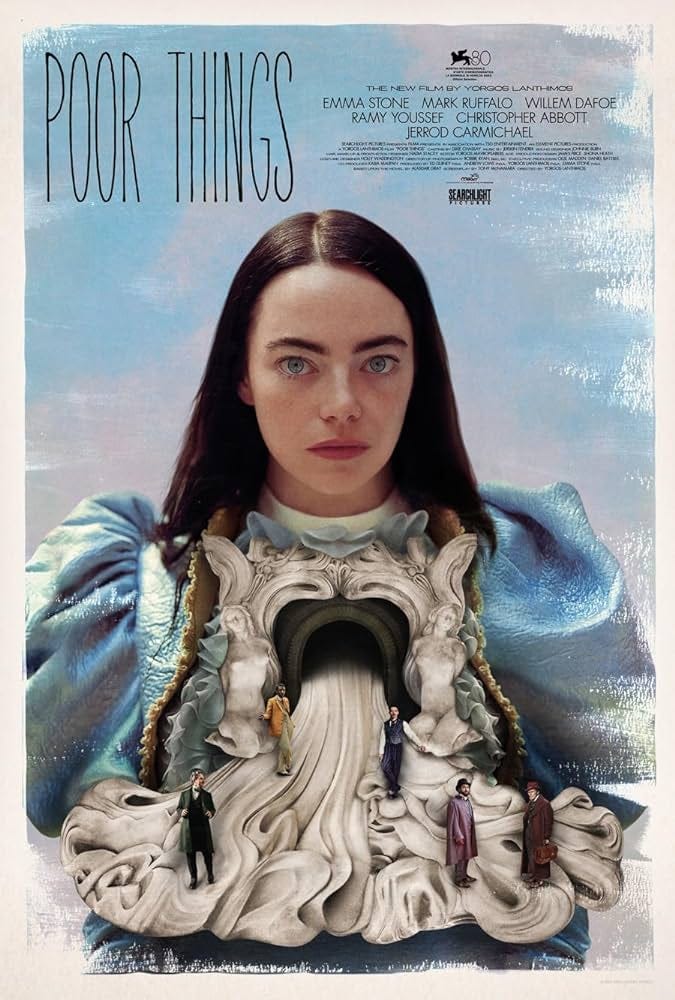
“I have adventured and found nothing but sugar and violence.”
So speaks Emma Stone’s “Bella” in the latest Yorgos Lathimos film, Poor Things. A woman revived from the dead and given new life with an infant brain courtesy of Willem Defoe’s Godwin Baxter (“God” for short). Bella’s world is one of constant discovery - she learns how to walk and talk, how to play, how to have sex, how to eat and drink and dance. She learns of a technicolor world (Lisbon, Paris, an ocean liner) full of delicious pastries, suffering children, male violence, sex work, pain and love.
In her juvenile and adolescent naïveté, Bella is passed from one man to another. From her “God” to the sweet student Max McCandless (“Candles,” played by the gorgeous Ramy Youssef) to the lecherous Duncan Wedderburn (Mark Ruffalo) and the even more terrifying Alfie Blessington (Christopher Abbott).
We learn that “Bella” is actually Victoria Blessington, a pregnant woman who threw herself off a bridge after suffering under the yoke of her cruel husband and enduring an unwanted pregnancy. Godwin Baxter pulls her body from the river, unaware of her identity, and implants the fetus’ brain inside. Bella is both mother and daughter, experiencing new life, but inside a body that has experienced life and death already.
This is where the film has two parallel, but equally moving stories. On the surface is the story of discovering the complexities of life - how language evolves and how we learn how complicated the real world is as we age and as we learn. Bella is crushed when she discovers her soft and privileged life is not an experience shared by all. When Harry Astley (Jerrod Carmichael) shows her the women and children suffering in poverty and squalor from the view of their luxurious dining room, Bella is broken. She gutturally weeps for a fact of life many of us have become hardened to, and conveniently ignore for the sake of our own happiness. Her fresh eyes see the pain and suffering for what they are. And in this sense the film is about exploring everything life has to offer - the “sugar and violence” together.
The second layer to the story, and the one I found even more compelling, is the story of Victoria Blessington, the woman who ends her own life and is given a new one. As someone who has come back from the brink of not wanting to live, I got emotional thinking about the film’s suggestion about starting over. Obviously I wasn’t given a new fetal brain to start from the beginning, but I resonated with Bella’s ability to move out of the London laboratory she was created in, explore the world, set her own terms and boundaries, and truly build a new life for herself away from her abusers and her sadness. Victoria’s life ended so Bella’s could begin, and I think a lot of us (especially queer folk) can relate to this metaphor of starting over from scratch in order to authentically experience the richness of life itself.
Bella learns how to go after what she wants, unfettered by the typical polite society customs that often hold us (but especially women) back from their desires. Bella becomes a Parisian sex worker because she likes sex, and she wants money. Despite the horror that some display at the supposed moral transgression, she herself does not carry the same baggage. She is free to discover what she likes and doesn’t like. She is able to act and think and talk in ways that Victoria Blessington was constantly denied. She gets to be herself.
Poor Things is also a technical marvel. The film begins in black and white, using a fisheye lens heavily in the opening hour or so. This had me sitting in the theatre thinking: “Oh my god, is the camera also developing like a newborn???” After the film ended, I literally googled how eyesight develops in infants. I think the transitions to color and wider camera angles suggests that the camera work develops (ha, camera pun) alongside Bella, an idea I found incredibly exciting. (even if it’s just my pet theory - if I ever get to interview Yorgos Lanthimos I’ll ask him about it.)
Other visual delights include clear homages to the futurism of the 1920’s - the scene where Bella is revived is a direct reference to the scene in Metropolis (1927, dir. Fritz Lang) in which Maria is turned into a robot by an evil scientist playing God.
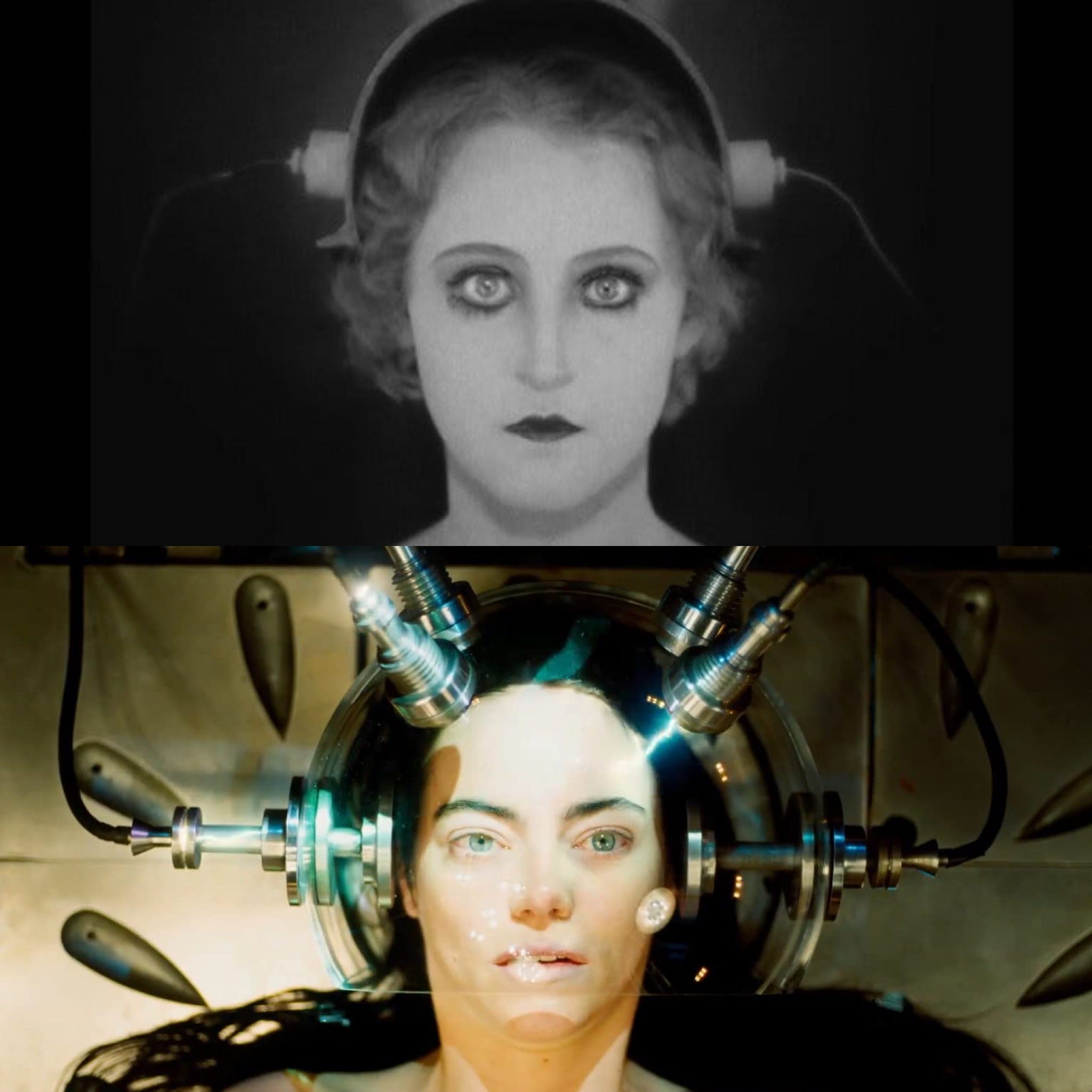
The backdrops are painted flats that resemble those of the early film era. The film also references’ the era’s fascination with the absurd. Expressionist images like animal hybrids, cogs and machinery, a mechanical carriage with a horse’s head on the front, and bubbling beakers all evoke the aesthetics of the surrealists and the Dada artists of the 1920’s. The score replicates the omnipresent, animated underscoring of a silent film. Even if these references to early 20th century art and film were not caught by everyone, it was just so enjoyable to take in, especially on a big screen.
Yorgos Lanthimos has such a gift in his willingness to take a big swing. His films feel like fully realized and lived-in worlds, where even the most absurd feels plausible. His films are charming, brutal, and unflinching. He does what many lazy filmmakers won’t - he takes big swings, but not just for shock’s sake. Instead, every move feels intentional yet spontaneous. Lanthimos makes art. And he is very quickly establishing himself as one of those directors whose films I must see in theaters as soon as they’re released, because I know that every time he will deliver a film chock full of sugar and violence.